Explained: Why Elsa Dutton’s Fate in ‘1883’ Changed the Entire ‘Yellowstone’ Universe

Who Is Elsa Dutton in ‘1883’?

Created by Taylor Sheridan as the first Yellowstone spin-off, 1883 follows the founding generation of the Dutton family in the days after the American Civil War. James (Tim McGraw) and Margaret Dutton (Faith Hill) travel from their home in Tennessee to start life anew along the Oregon Trail. Upon reaching Fort Worth, Texas, James joins a wagon train led by Shea Brennan (Sam Elliott), while Margaret takes a train with her children to keep them safe. Although the Duttons never reach the Oregon Trail, they settle in Montana, where they build a family business and expand their land control in what eventually becomes the Dutton Ranch.
What Happened to Elsa Dutton in ‘1883’?

The hardscrabble journey from Tennessee to Texas and then Montana proved quite difficult for Elsa Dutton in 1883. As she comes of age and learns the harsh nature of life outside her hometown, Elsa experiences the loss of her first true love, Ennis (Eric Nelsen), a charming cowboy who is hired to protect the family and guide them to Montana. Ennis died protecting Elsa and her family from ruthless prairie bandits, causing her heartache and deep consternation.

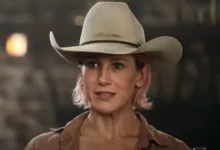


Elsa Dutton’s Tragic Fate, Explained

Elsa Dutton’s tragic fate began in 1883‘s penultimate episode, “Racing Clouds.” The wagon train enters dangerous Lakota territory, where the German immigrant Josef (Marc Rissmann) is bitten by a rattlesnake and his wife, Risa (Anna Fiamora), is tossed from the carriage and suffers a fatal brain injury. A harbinger of absolute doom, things only worsen for Shea and James. They ride past a harrowing massacre of Lakota women and children. Knowing they would be blamed for the massacre, Shea and James set out to find those responsible for the massacre. Elsa and Margaret are left behind in Lakota territory when the other members of the wagon train seek refuge at a nearby Army fort. Although Shea and James catch and kill those who slaughtered the Lakota victims, it comes at nearly an equal price. In their absence, the Lakota attack Elsa and the remaining settlers, killing Cookie (James Jordan). Elsa bravely fights back and fires a gun at one of the Lakota. In return, the Lakota warrior fires an arrow that pierces Elsa in her torso. Although Elsa manages to de-escalate the fight by speaking in a native language taught to her by Sam, Elsa’s wound worsens considerably. Makeshift efforts to treat her wound are made on the spot, with the episode ending with James telling Margaret that Elsa will die soon.
In 1883‘s finale, “This is Not Your Heaven,” Elsa’s spirit is honored with great reverence. As James and Shea lead the group into Wyoming Territory to find help, they cannot locate a doctor capable of treating Elsa or performing the necessary surgery. When her wound is confirmed to be life-threatening, the locals implore James to take her to Fort Laramie to find a surgeon. With Fort Laramie too far away, Elsa receives treatment from a compassionate Crow tribe in town. Knowing that death is imminent, Elsa writes the final chapter in her own story by deciding where she wants to be buried for all eternity. By now, viewers realize that Elsa’s sorrowful narration throughout the series has built up to this moment of immense grief and sadness. The Crow people treating Elsa’s wound suggest that the Duttons take her to Paradise Valley, Montana, and begin life anew. James and Margaret agree and take their daughter to Paradise Valley, close to the Yellowstone River. When they arrive, Elsa dies peacefully in James’ arms beneath a tree. Far from her death being in vain, James and Margaret honor Elsa’s tragic demise by founding the Dutton Family Ranch in Montana near Elsa’s burial site. As Elsa narrates her own tragic story, she expresses gratitude for being part of the founding family that continued through the generations, as seen in 1923 and Yellowstone. Without Elsa’s heroic sacrifice to fight off the ambushing Lakota, the Duttons may never have called Montana home for the next century.